When Will the Luminosity Controller Be Available Again
Anatomy Of A Feedback Control Organisation
Here is the classic block diagram of a procedure under PID Command.
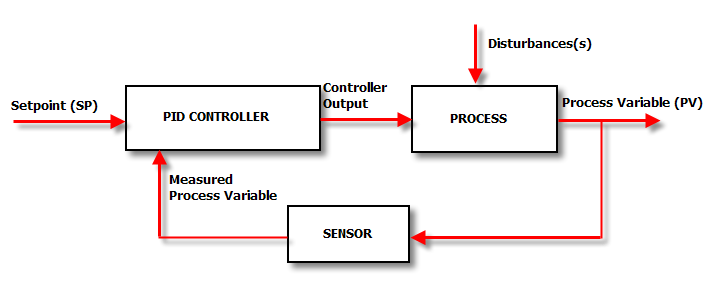
What's going on this diagram?
The Setpoint (SP) is the value that we want the process to be.
For case, the temperature command organisation in our house may have a SP of 22°C. This means that
"we desire the heating and cooling process in our house to achieve a steady temperature of as close to 22°C equally possible"
The PID controller looks at the setpoint and compares it with the actual value of the Process Variable (PV). Back in our house, the box of electronics that is the PID controller in our Heating and Cooling system looks at the value of the temperature sensor in the room and sees how shut it is to 22°C.
If the SP and the PV are the same – and then the controller is a very happy little box. It doesn't have to practise anything, it will ready its output to zero.
Nevertheless, if there is a disparity between the SP and the PV we have an error and corrective action is needed. In our firm this volition either be cooling or heating depending on whether the PV is higher or lower than the SP respectively.
Let's imagine the temperature PV in our house is college than the SP. Information technology is too hot. The air-con is switched on and the temperature drops.
The sensor picks up the lower temperature, feeds that back to the controller, the controller sees that the "temperature error" is not as bang-up because the PV (temperature) has dropped and the air con is turned down a little.
This process is repeated until the house has cooled downwards to 22°C and there is no mistake.
Then a disturbance hits the system and the controller has to kick in again.
In our firm the disturbance may exist the sunday chirapsia down on the roof, raising the temperature of the air inside.
And so that'due south a really, really bones overview of a simple feedback control organization. Sounds dead simple eh?
Understanding the controller
Unfortunately, in the existent world we need a controller that is a chip more complicated than the one described above, if we want top performance from our loops. To sympathize why, nosotros will be doing some "thought experiments" where we are the controller.
When we have gone through these thought experiments we will capeesh why a PID algorithm is needed and why/how it works to control the process.
We will be using the analogy of irresolute lanes on a expressway on a windy day. Nosotros are the driver, and therefore the controller of the process of changing the automobile's position.
Here's the Block Diagram we used before, with the labels changed to represent the car-on-windy-thruway command loop.
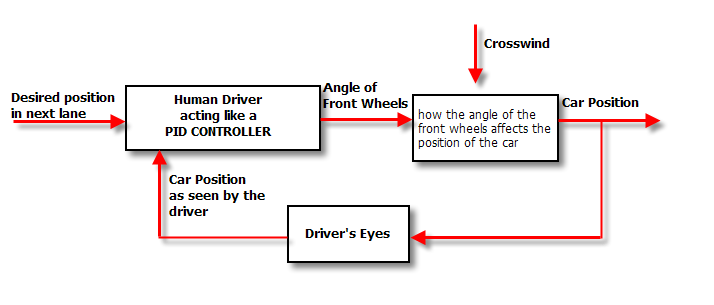
Notice how important endmost the feedback loop is. If we removed the feedback loop we would be in "open loop control", and would have to control the machine'south position with our eyes airtight!
Thankfully we are nether "Airtight loop command" -using our eyes for position feedback.
Equally nosotros saw in the house-temperature example the controller takes the both the PV and SP signals, which it so puts through a black box to calculate a controller output. That controller output is sent to an actuator which moves to actually control the process.
We are interested here in what the black box actually does, which is that it applies 1, 2 or 3 calculations to the SP and Measured PV signals. These calculations, called the "Modes of Control" include:
-
Proportional (P)
-
Integral (I)
-
Derivative (D)
Nether The Hood Of The PID Controller
Hither's a simplified block diagram of what the PID controller does:
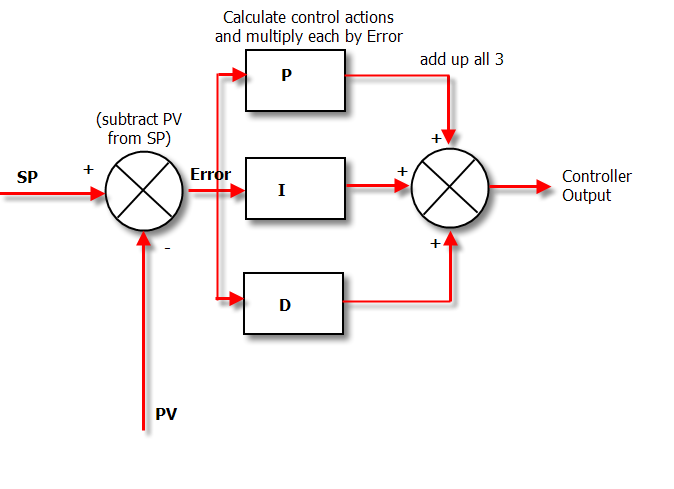
It is really very elementary in operation. The PV is subtracted from the SP to create the Error. The error is just multiplied past one, two or all of the calculated P, I and D actions (depending which ones are turned on). Then the resulting "error 10 command deportment" are added together and sent to the controller output.
These three modes are used in different combinations:
P – Sometimes used
PI - Most often used
PID – Sometimes used
PD – rare as hen'south teeth but tin can be useful for controlling servomotors.
Derivatives
Get into the control room of a process plant and ask the operator:
"What's the derivative of reactor iv's pressure level?"
And the response volition typically exist:
"Bugger off smart arse!"
However go in and enquire:
"What's the rate of change of reactor 4'south pressure?"
And the operator will examine the pressure tendency and say something like:
"Near 5 PSI every ten minutes"
He'south just performed calculus on the pressure tendency! (don't tell him though or he'll want a pay raise)
So derivative is just a mathematical term meaning rate-of-modify. That's all there is to it.
Integrals without the Math
Is it whatsoever wonder that so many people run scared from the concept of integrals and integration, when this is a typical definition?
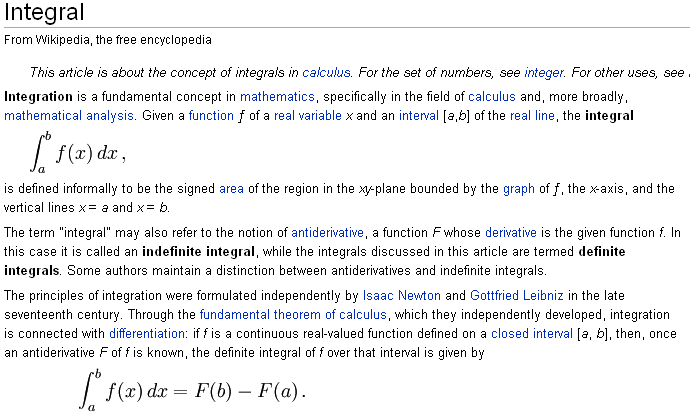
What the!?!?
If you understood that you are a smarter person than me.
Hither's a plain English language definition:
The integral of a signal is the sum of all the instantaneous values that the signal has been, from whenever yous started counting until you stop counting.
Then if you lot are to plot your signal on a trend and your bespeak is sampled every second, and let's say you are measuring temperature. If you were to superimpose the integral of the betoken over the first 5 seconds – information technology would look like this:
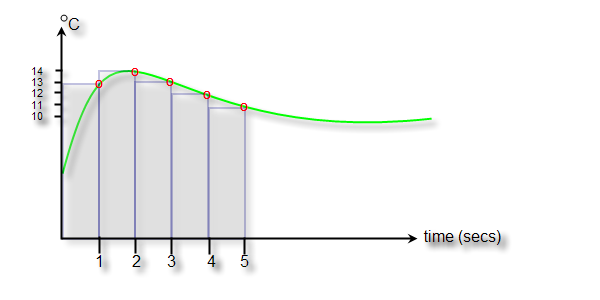
The green line is your temperature, the red circles are where your control system has sampled the temperature and the blue area is the integral of the temperature signal. It is the sum of the v temperature values over the time period that you are interested in. In numerical terms information technology is the sum of the areas of each of the blue rectangles:
(xiii 10 ane)+(14x1)+(13x1)+(12x1)+(11x1) = 63 °C s
The curious units (degrees Celsius x seconds) are because we have to multiply a temperature by a fourth dimension – but the units aren't of import.
As you can probably remember from schoolhouse –the integral turns out to be the expanse under the curve. When we have real globe systems, we actually get an approximation to the area under the curve, which equally you can encounter from the diagram gets better, the faster we sample.
Proportional command
Here's a diagram of the controller when we accept enabled merely P command:
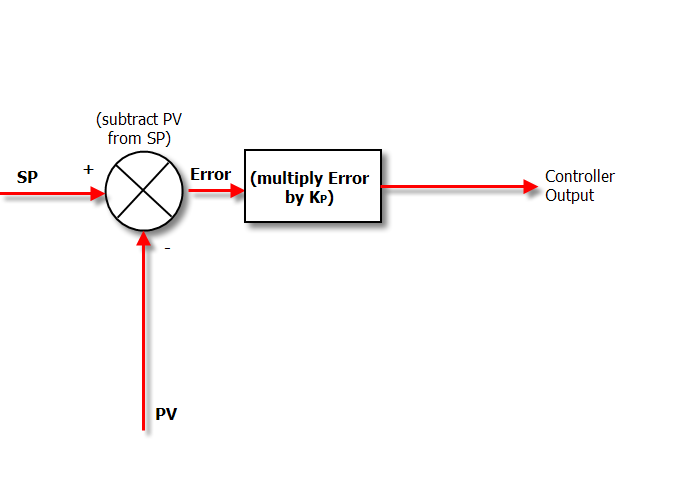
In Proportional But mode, the controller simply multiplies the Fault by the Proportional Gain (Kp) to get the controller output.
The Proportional Gain is the setting that we tune to become our desired performance from a "P simply" controller.
A match made in heaven: The P + I Controller
If we put Proportional and Integral Action together, we go the humble PI controller. The Diagram below shows how the algorithm in a PI controller is calculated.
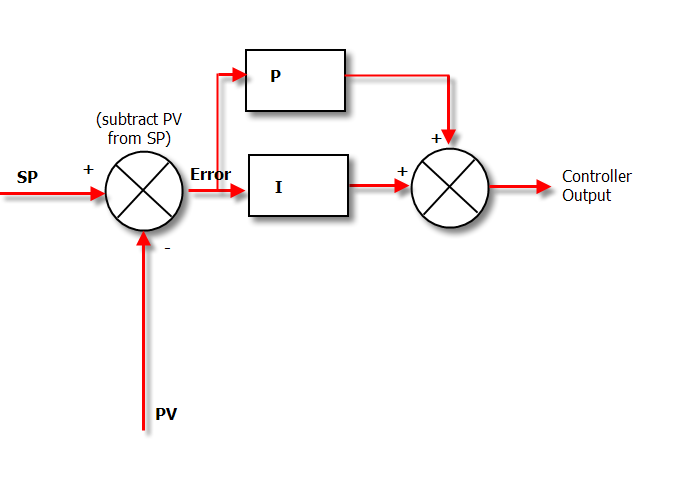
The catchy matter most Integral Action is that information technology will really spiral upwards your process unless you know exactly how much Integral action to apply.
A good PID Tuning technique will summate exactly how much Integral to apply for your specific process - simply how is the Integral Action adjusted in the get-go identify?
Adjusting the Integral Action
The way to arrange how much Integral Action you have is past adjusting a term chosen "minutes per repeat". Non a very intuitive name is it?
And so where does this strange name come up from? It is a measure of how long it will accept for the Integral Action to match the Proportional Action.
In other words, if the output of the proportional box on the diagram above is twenty%, the repeat time is the time information technology will take for the output of the Integral box to get to twenty% too.
And the important betoken to note is that the "bigger" integral action, the quicker information technology volition go this 20% value. That is, it will take fewer minutes to become there, so the "minutes per echo" value will exist smaller.
In other words the smaller the "minutes per repeat" is the bigger the integral action.
To make things a bit more intuitive, a lot of controllers use an alternative unit of "repeats per minute" which is obviously the inverse of "minutes per repeat".
The nice matter about "repeats per minute" is that the bigger it is - the bigger the resulting Integral activeness is.
Derivative Action – predicting the future
OK, so the combination of P and I action seems to cover all the bases and do a pretty expert job of decision-making our system. That is the reason that PI controllers are the most prevalent. They do the job well enough and keep things simple. Great.
Merely engineers being engineers are e'er looking to tweak operation.
They do this in a PID loop by calculation the final ingredient: Derivative Action.
So adding derivative activity can allow you to have bigger P and I gains and all the same keep the loop stable, giving you a faster response and meliorate loop functioning.
If you call up most it, Derivative activeness improves the controller action because it predicts what is yet to happen past projecting the electric current rate of change into the future. This ways that it is non using the current measured value, but a future measured value.
The units used for derivative activity describe how far into the future you want to look. i.east. If derivative action is twenty seconds, the derivative term volition project the current rate of change 20 seconds into the future.
The big problem with D control is that if you have noise on your signal (which looks similar a agglomeration of spikes with steep sides) this confuses the hell out of the algorithm. It looks at the gradient of the noise-spike and thinks:
"Holy crap! This process is changing rapidly, lets pile on the D Action!!!"
And your control output jumps all over the place, messing upwardly your control.
Of course yous can try and filter the noise out, simply my advice is that, unless PI control is really irksome, don't worry most switching D on.
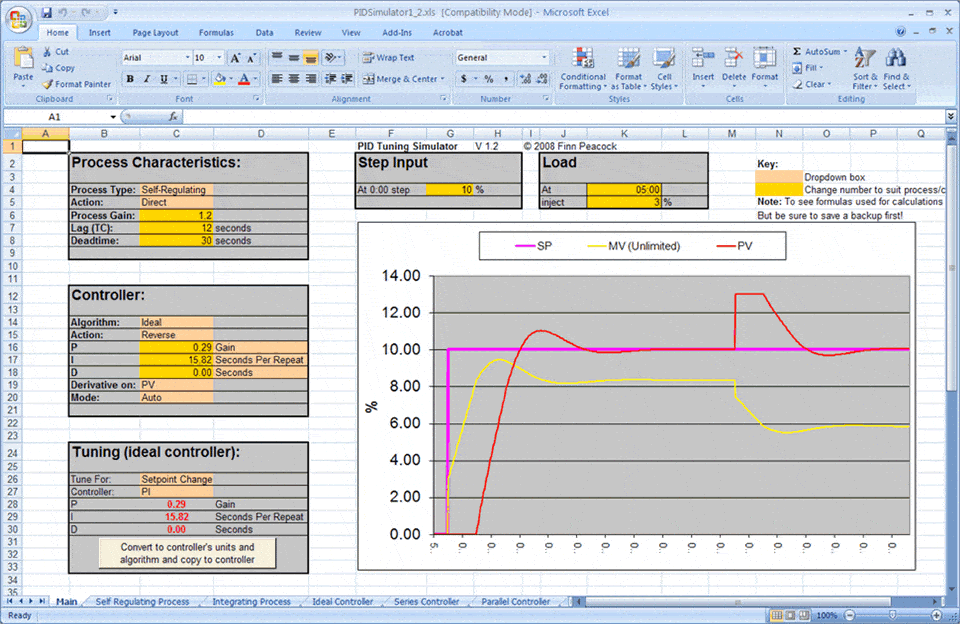
Another annotation from Jim: "Whether learning about PID and how the parameters affect performance, or trying to tune a process, simulation is an important tool for getting PID right. Finn Peacock has a simulation tool bachelor that runs in Microsoft Excel. Over the years, I take written a lot of different simulation programs while developing PID algorithms for everything from industrial process controls to scientific research apparatus on the NASA Infinite Shuttle. If this spread sheet had been available then, it would have saved me a lot of time. You can go a copy of this simulation tool (screen shot beneath) as part of the Pro package available from Finn Peacock at www.pidtuning.internet. Again, I don't make a dime off this. I just found it valuable and wanted to pass it along."
lyonsbeetting1968.blogspot.com
Source: https://www.csimn.com/CSI_pages/PIDforDummies.html

Post a Comment for "When Will the Luminosity Controller Be Available Again"