Will Lara Croft Be Sexy Again
Since Lara Croft blew up gaming culture in 1996 with the starting time installment of Tomb Raider, her graphic symbol has been so predominantly defined by her sex appeal that two decades on, we're nevertheless trying to extricate conversations about her from conversations about her breasts.
Lara Croft has always been a cultural flashpoint, e'er in direct relation to her gender. Over the years, she's as well served every bit an instance of gaming development, particularly in terms of graphic pattern. Merely it'southward virtually impossible to discover an abiding cultural chat about Lara that doesn't ultimately return to debate over whether she'south an empowering character.
And it'southward impossible to consider her as a graphic symbol without also considering the office she holds within gaming as essentially the get-go, and yet 1 of the merely, female characters to helm an action gaming franchise.
Lara Croft was the original " cyberbabe" — but from the beginning, she was also a whole lot more
When Tomb Raider offset appeared on the scene, swiftly followed by Tomb Raider 2 a year later, Lara Croft was critiqued as belonging to a long cultural tradition of science-fiction fembots. With her "polygonal breasts" and breathy voice, it was hard for some critics to see her equally representing more than a digitized sexual fantasy. A flurry of user-made game patches with titles like "Nude Raider," fabricated solely for the purpose of removing her apparel to reveal her pixellated torso, didn't help that impression.
"Launching a franchise with a female archaeologist was seen as a novel concept," Samit Sarkar, an editor at Vox's sister site Polygon, told me. "Her graphic symbol model was relatively primitive, since 3D graphics were in their infancy at the time, simply information technology was plainly obvious that she was designed as an adolescent male fantasy: chest twice equally wide equally her waist, teal tank top, khaki booty shorts. At the same time, she had a take-no-guff mental attitude and dry British wit that people latched onto, and her video game exploits were, of course, badass."
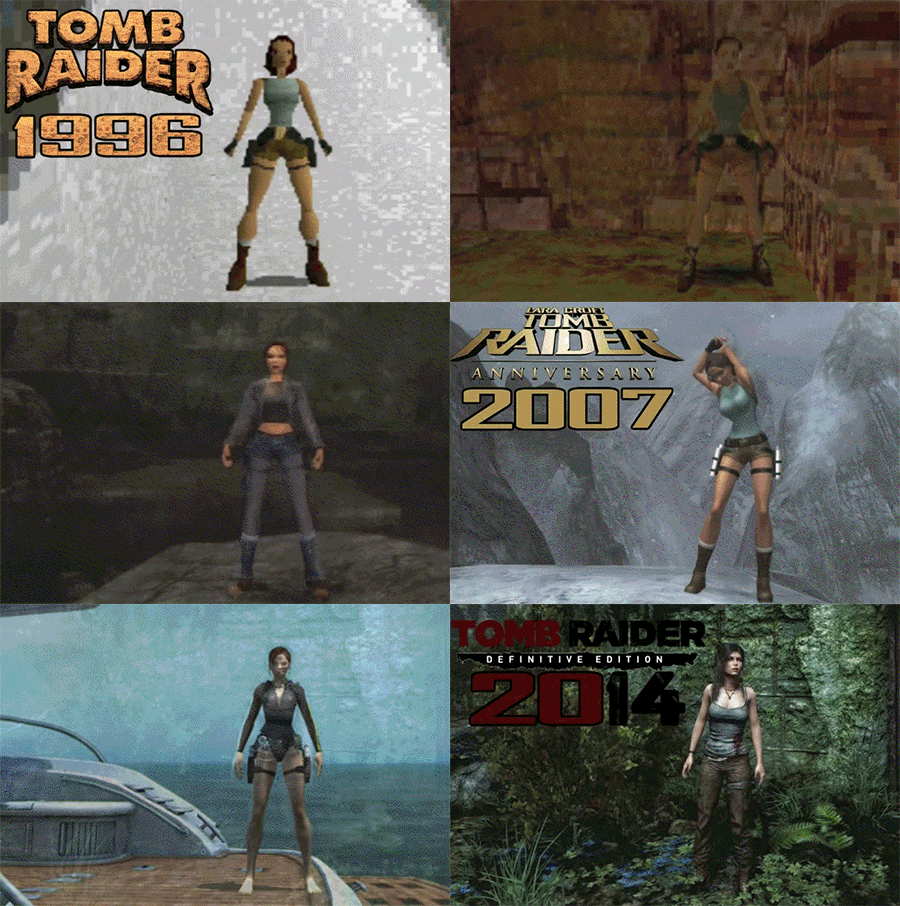
By 2000, the media was crediting Lara with originating the concept of the "cyberbabe." The idea of the hyper-unrealistic female game character who served as a repository for male fantasies would proceed to become a much-parodied and much-debated part of gaming culture. And the apparent contradiction between Croft's sexual appeal and her sophisticated persona would spawn two decades of cultural ambivalence about what kind of character she was. "The battle between these parts of Lara defines the debate around her grapheme," Sarkar said.
Ironically, Lara's sex appeal is as well what fabricated her i of gaming's most groundbreaking characters. If she'd been less sexy, she arguably couldn't have gotten away with being the lead of a video game franchise — and that was huge. Bated from 1981'due south Ms. Pac-Human and a twist catastrophe of Nintendo'due south 1986 game Metroid that revealed the lead character to have been a woman all along, major game franchises basically didn't have playable female person characters as their leads at that point in the medium'southward history.
Lara Croft was a huge exception to a rule that still sadly holds true for much of the gaming manufacture today: building a franchise around a female lead is seen every bit a risk. In an unpublished study whose data was reportedly shared with gaming site Penny Arcade in 2012, the video game enquiry visitor EEDAR constitute that just 3.vi percent of virtually 700 games it surveyed had playable characters that were exclusively women — that is, female characters who couldn't exist swapped out with a male avatar. And the games in the written report with male-only playable characters were said to take sold amend than the ones that included women.
And then Lara was, in at least one sense, an boggling example of female empowerment. It was rare enough that she helmed a franchise in which players can only play as a woman — but that franchise was also a worldwide bestselling cultural phenomenon. Lara, in her earliest incarnations, may have been a fembot, simply if male gamers wanted to fantasize most her, they had to get to know her outset.
And at that place was a lot to go to know. As "the female Indiana Jones," Lara was aloof, filthy rich, highly educated, adventurous, and a technological wunderkind. She even killed Bigfoot. In 1998, the British Ministry building of Science named her as an administrator for British scientific excellence.
But despite these character traits, she was still seen primarily as a sexual object — and, disturbingly, as a ability fantasy for male gamers who enjoyed having straight command over her. In a 2000 interview with one of her creators, Adrian Smith, he described her as "delicate ... someone y'all'll desire to protect and nurture." This idea would surface again over her franchise history, most notably in 2012. He also presented her as a universal romantic fantasy — for directly men like himself. When asked, "What'due south Lara looking for in a soul mate?" he responded, "Definitely someone like myself: suave and sophisticated."
Though Tomb Raider's original publisher Eidos wanted to keep her prototype strictly PG, information technology also didn't fifty-fifty effort to pretend Lara appealed to women, as seen in the game's 1997 "Where the boys are" ad campaign, which suggested men were abandoning traditional male spaces — including a strip club — to go hang out with Lara.
In 1999, Eidos went to court to keep Lara'due south name and the Tomb Raider logo out of Playboy, successfully arguing that such a public association of the character with pornography would forever ruin her paradigm. By that point, all the same, it was articulate that Lara's design was part of the problem.
The cultural conversation nearly Lara has always involved her breast size
Though most people associate Lara Croft with gaming culture'southward trouble of sexual objectification, the truth is that she's probably less representative than you recollect. In fact, a 2022 study examining three decades of gender representation in games found that "extreme sexualization" of women — all the traits Lara Croft came to embody, rightly or wrongly — really reached their peak in 1995, the year before Lara appeared on the scene.
So when because that nosotros take spent two decades being fixated on Lara Croft's cup size, information technology'southward helpful to keep in heed that this ongoing cultural conversation about boobs has arguably done more to curb systemic sexual objectification in gaming than to perpetuate it.
Part of the reason for the abiding scrutiny of Lara's boobs — which famously got larger in the 2nd installment of the game, allegedly due to a coding error that the developer decided to go along — is that in the tardily '90s, larger questions about who was meant to play Tomb Raider and relate to Lara Croft kept getting derailed by the effect of whether women could relate to her if they didn't also take enormous breasts.
For the 1998 essay collection From Barbie to Mortal Kombat: Gender in Video Games, Cal Jones, so the reviews editor for PC Gaming World, articulated an argument that would recur throughout Lara's history: that her incommunicable anatomy made her a sham of a feminist part model, and that women (and himself) knew ameliorate than to fall for it. "Lara, get those melons out of your vest and I'll like y'all a whole lot better," he concluded.
In 1997, the Contained lightly examined the style tabloids had been ranking potential actresses who could play Lara based primarily on their breast size. Teenage girls were supposedly driven to go breast implants because of her. The models who played her were hailed for matching her concrete proportions.
In essence, while it was assumed that male gamers would be eager to embrace Lara because she was hot, the idea that women could besides relate to her if they didn't mirror her physically was hotly contested.
There also seemed to be a nebulous sense of unease effectually the idea that Lara was virtual and not real — that we could inhabit her and even manipulate her, just never fully know her. The perpetual word about her breasts, and so, may accept served as a way to both negotiate and combat this anxiety.
At commencement, the word mainly fixated on the weird triangle boob upshot caused past the early on days of graphics, and the mode information technology emphasized just how alien she was to the typical presentation of a male sexual fantasy. But update after update, the chest chat kept right on coming. And the more physical we fabricated her, the more than we kept her cyborg-like nature at bay.
The focus on her cleavage as well, of course, gave us a perennial starting bespeak for larger discussions about the depiction of women in the media. In 2015, for instance, a website devoted to fighting eating disorders depicted Lara with anatomically realistic proportions as office of a series devoted to pointing out how unnaturally women are depicted in game blueprint.
As gaming culture advanced, the mainstay conversation about her physical advent also began to expand and overlap with an emerging critique of an archetype she had arguably helped originate.
Is Lara Croft a stiff female person character? Or a "Stiff Female Character " ?
:format(webp):no_upscale()/cdn.vox-cdn.com/uploads/chorus_asset/file/10442377/3115495_riseofthetombraider_bloodties_04_1471346558.jpg)
Lara Croft's success is built on a number of paradoxes. She had a list of badass character traits, but was also, for nearly of her franchise, a total cipher with zero development. For all the conversation about her boobs, early installments of the game showed her from behind most of the time during the actual gameplay. According to her own creator, she was simultaneously "potent" and "fragile." She was a virtual fantasy, merely was made flesh and blood by the first Tomb Raider movies starring Angelina Jolie — which necessitated yet more than discussion about cup size.
All of this made her synonymous with a conversation that recurred throughout geek culture in the late-aughts and early tens: the issue of the "strong female person character" and the pernicious embedded sexism within its presentation as a form of female empowerment.
For well-nigh of the first decade of her existence, Lara was lauded as a stiff female person character — no quotes. But as conversations about depictions of women in media began to evolve, and notions most popular civilisation tropes began to expand, the early on critiques of her character every bit anti-feminist began to render. Lara increasingly began to be seen as an case of a character whose "strength" is deceptive, usually depicted as purely concrete, while her main purpose is to placate the male gaze, and her overall character satisfies a patriarchal depiction of femininity.
This critique got a major boost from 2013'south Tomb Raider reboot and the subsequent 2022 sequel Rise of the Tomb Raider. Equally function of the press around the reboot'southward evolution, in 2012, Eidos announced that "yous'll want to protect" the new Lara Croft — from sexual assault. This famously caused a gaming community firestorm around the trope that equates female "strength" to forcing them to survive sexualized violence. (Though Eidos downplayed the element of sexual set on after it drew backlash, information technology's notwithstanding arguably present in the ultimate version players experienced.)
The Tomb Raider reboots provided a cultural touchstone for emergent criticism of the Strong Female Character archetype, while also providing a space for reimagining what that archetype might look like from a more overtly feminist perspective. Crucially, the new Alicia Vikander Tomb Raider drew heavily upon the reboot and sequel, and has carried all of the franchise's frustrating litany of paradoxes along with it. "Can Lara Croft e'er really be a feminist icon?" Mashable'southward Jess Joho asked in response to the film:
Lara once over again feels like a woman who was not birthed from a womb, simply rather sprung from the mind of a patriarch, fully formed, like your modernistic-twenty-four hours Athena in a ripped tank elevation.
And fundamentally, that's precisely what Lara Croft is. She began as the pixelated creation of a man, molded for the consumption of a presumed male audition, and continually iterated upon by teams made up of predominantly men. Aye, both the new games and movie have women in lead writing roles. Only evidently, one woman'south voice cannot retroactively undo decades of Lara serving as a virtual plaything for boys and men.
Former game developer (and current congressional candidate) Brianna Wu told me she "never cared much well-nigh Lara Croft until the 2013 Tomb Raider considering so much of the conversation was about her body. It felt like she was yet some other character created for men." Now, however, the focus is — finally, hopefully — off her torso, Wu says, and "is now nigh her internal struggle to exist more than she is."
Just as much every bit fans like Joho and Wu are fix for a more than nuanced version of Lara, some male critics and fans have taken issue with Vikander'due south version every bit too nuanced. In a much-maligned piece for PhillyVoice, writer Jerome Maida blasted the new Lara's lack of sex appeal and "interchangeability" with whatsoever male character (comments that have since been redacted from his review). Others just kept focusing on her boobs.
"A lot of this discussion is about male geeks marking their territory," Wu told me. "They liked it just fine when Lara Croft was a character created for their satisfaction. And they honestly can't empathise what others see in her."
But Lara clearly resonates with women who've long been treated equally afterthoughts in the gaming world. "There'due south a reason when y'all go to Pax [a nationwide series of gaming conventions] you meet so many women cosplaying her," Wu said. "I know I identify fiercely with her — and I'm not the only one."
How far this cultural reappraisal will carry the Tomb Raider franchise into the futurity is anyone's approximate — but information technology's clear that the ongoing tendency of reevaluating and reframing Lara Croft as a feminist icon has even so to outstay its welcome. The many paradoxes of Lara Croft have helped shape depictions of women in the first decades 21st century, and volition be with us for a long time to come.
lyonsbeetting1968.blogspot.com
Source: https://www.vox.com/culture/2018/3/17/17128344/lara-croft-tomb-raider-history-controversy-breasts

Post a Comment for "Will Lara Croft Be Sexy Again"